
For over three decades, MAYDAY has not only marked the transition from April to May, but also signalled a state of emergency within the electronic music scene. As one of Europe’s longest-running indoor festivals, MAYDAY brings together techno history, international club culture, and contemporary sound visions. MAYDAY embodies energy, change and community — a place where generations dance together, boundaries blur and electronic music becomes a cultural constant.
Born out of the spirit of the early rave and techno movements, MAYDAY emerged in 1991 as a statement for freedom, electronic music and a new youth culture. What began as a scene event has developed into an annual fixture in the international festival calendar. Despite its growing size, the core concept has remained the same: music as a unifying force, embraced by a community that embraces change. Musically, MAYDAY is deeply rooted in techno but also embraces related genres such as house, trance, hard techno and experimental hybrid forms. The line-up reflects different generations, with pioneers meeting new voices and raw energy meeting precise production. The sound is uncompromising, driving and sometimes demanding, but always collectively conceived.

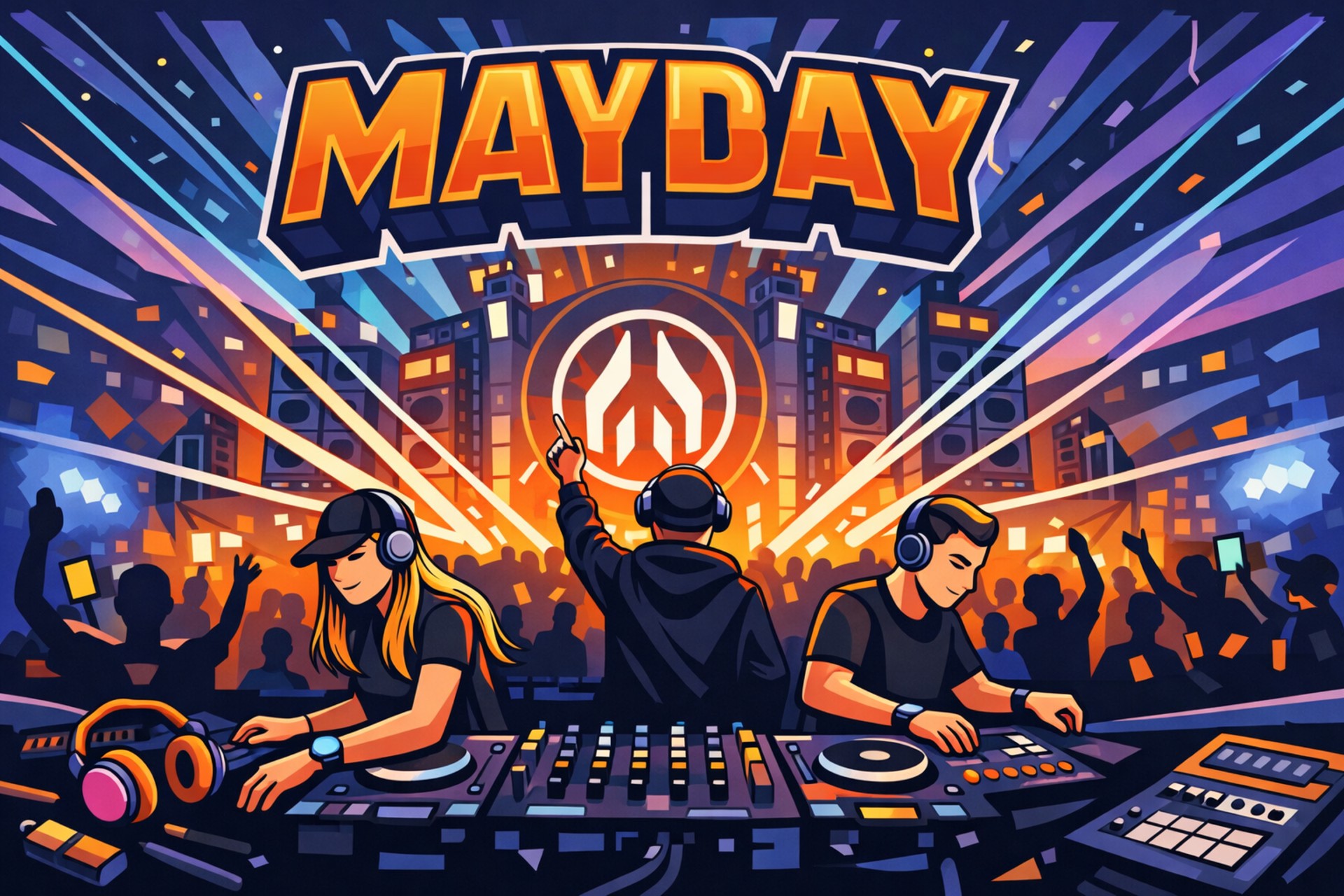
As a classic indoor festival, MAYDAY in Dortmund, Germany, creates its own world of monumental stages, industrial aesthetics and precise lighting design. Lasers cut through the fog, visuals pulse to the beat and concrete becomes a canvas. Lasers cut through fog, visuals pulsate to the beat and concrete becomes a canvas. The location is functional, built for sound, movement and ecstasy. It is urban, raw and focused on the essentials: the moment. Over the years, MAYDAY has increasingly created space for female artists and diverse perspectives. DJs and producers shape the programme with their unique sounds and clear attitudes. Equality is not seen as a passing fad here, but as an integral part of a thriving scene, evident on stage and in the audience.
What MAYDAY is all about are legendary sunrise sets, surprising back-to-backs and tracks that carry thousands at once. These are moments when time loses its meaning and music becomes a universal language. Many of these moments are captured in aftermovies, live recordings or scene reports, and they have an impact that extends far beyond the night itself. MAYDAY is more than just a festival. It is a meeting place for an international community, a ritual and a cultural statement. Here, people of all ages dance together, united by bass, attitude, and respect. Sustainability, openness, and scene awareness are integral to the identity, not marginal issues.